Cumberland County, PA Anxiety, PTSD, and Trauma Therapy
EMDR, CBT, DBT, PE, Brainspotting and More
In-Person in Lancaster (~40 Miles) or Secure Telehealth — Specialized Care for the Cumberland Valley's Military Families and Beyond
Advanced Counseling and Research Services
Office Location & Hours (Lancaster)
313 W Liberty St STE 224, Lancaster, PA 17603
Mon–Thu 9am–7pm | Fri 9am–5pm
~40 miles from Carlisle via I-76 E or US-30 E (about 45–50 minutes) Open in Google Maps
Cumberland County is home to the nation's second-oldest military installation, one of the Army's premier senior leadership schools, a major naval support command, and a county that has been at the center of American military history since the French and Indian War. It is also home to thousands of veterans, active-duty families, and civilians whose service-connected trauma, military family stress, and career-related anxiety deserve the most specialized clinical care available. Lancaster is 40 miles east. Healing starts here.

Cumberland County, Pennsylvania — Carlisle, Mechanicsburg, Camp Hill, Shippensburg, Newville, and the growing communities spreading across the Cumberland Valley between Blue Mountain to the north and Yellow Breeches Creek to the south — is one of Pennsylvania's most economically dynamic and historically significant counties. With a 2023 population of approximately 270,738 and consistently one of the lowest unemployment rates in the state, Cumberland County functions as the western anchor of the Harrisburg metropolitan area, a county that has grown steadily as the state capital's suburbs have expanded up the valley and as federal and military employment has increased.
Two military installations define much of the county's identity and significantly shape its community's mental health needs. Carlisle Barracks — the nation's second-oldest active military installation, with first structures dating to 1757 and a continuous military presence through the Revolutionary War, the Civil War, both World Wars, and every conflict since — is home to the United States Army War College, the Army's senior professional military education institution, where senior officers from across the services and allied nations complete a demanding one-year residency in strategic leadership. NSA Mechanicsburg — the Naval Support Activity in Mechanicsburg — is a major naval logistics and support installation that employs thousands of civilian and military personnel in eastern Cumberland County. Together, these two installations create a county with an unusually large population of high-ranking military officers, active-duty families navigating frequent moves and deployments, combat veterans in senior career transitions, and civilian federal workers supporting national security missions.
Cumberland County's post-9/11 veteran population is the county's largest by conflict — the data shows Gulf War (2001–) veterans at 1.2 times the representation of any other conflict. The county has been producing, training, and supporting American military personnel through every conflict from the French and Indian War to the present. The specialized trauma and PTSD care that population needs is not adequately met by general mental health providers — and ACRS's certified traumatologists, trained specifically in veteran PTSD, military family stress, combat trauma, and the particular challenges of high-performing individuals who are reluctant to seek help, are exactly the clinicians this community deserves.
Lancaster is approximately 40 miles east of Carlisle — about 45 to 50 minutes via I-76 East or US-30 East. ACRS offers both in-person sessions at our Lancaster office and fully secure telehealth for Cumberland County residents who prefer the privacy, schedule flexibility, or geographic convenience of remote care. Healing starts here.

Post-Traumatic Stress Disorder (PTSD) — Including Combat-Related
Substance Use & Co-Occurring Disorders
Trauma — Single Event and Complex/Chronic
Veteran & Active-Duty PTSD
Cumberland County's Specific Trauma Profile — Military Families, Veteran PTSD, and the Hidden Costs of Service in a Garrison Community
Cumberland County's trauma profile is shaped more by its military identity than by post-industrial economic loss — and that makes it specific in ways that general mental health providers are often not trained to address. Our certified clinical trauma professionals are trained to work with exactly these experiences:
Combat veteran PTSD — especially for the post-9/11 generation now at senior career stages: Cumberland County's largest veteran population served in the Gulf War (2001–), making this a county with a very high concentration of Iraq and Afghanistan-era veterans, many of whom are now senior officers completing Army War College or senior civilian careers at the installations. Post-9/11 combat PTSD presents in specific ways — hypervigilance, moral injury from asymmetric warfare, survivor guilt, traumatic brain injury co-occurrence, and the particular difficulty of seeking help while simultaneously holding senior leadership responsibility. ACRS's Certified Traumatologists are trained in EMDR, Brainspotting, and Prolonged Exposure — all gold-standard, evidence-based treatments for combat-related PTSD — and provide fully confidential care that is completely invisible to the military career system. What happens in your session is between you and your clinician, with no military chain-of-command visibility.
The specific psychological burden of Army War College year — high-performing officers navigating career transition stress: Senior officers completing the Army War College one-year residency in Carlisle are an unusual population: high-achieving, operationally experienced, often post-deployment, tasked with intellectual performance in a senior academic environment, frequently away from their primary support networks, and living in a tight-knit military community where professional reputation is always visible. The combination of unprocessed combat and operational trauma from prior deployments, career-transition stress, family relocation anxiety, and the high-performance academic demands of the War College creates a specific and often unacknowledged psychological burden. ACRS provides fully confidential care — via telehealth from your quarters or in person in Lancaster — that is invisible to your Army War College cohort, your faculty, and your command.
Military family stress, secondary trauma, and the compounding burden of frequent relocation: Military spouses and families at Carlisle Barracks and NSA Mechanicsburg navigate a specific form of chronic stress that is widely underrecognized as a clinical concern: repeated uprooting as the service member moves assignments; rebuilding social and professional networks from scratch every two to three years; managing children's education across multiple school systems; career disruption for the non-service-member spouse; and sustained anxiety about deployment and its risks. The spouse who has moved seven times in twelve years of marriage, rebuilt a career network four times, and managed three children through school changes while the service member deployed — that person carries a specific, compound, and largely unacknowledged psychological load that ACRS is specifically trained to recognize and treat.
Moral injury from service — the specific form of trauma most common in senior military leaders: Moral injury — the damage done by perpetrating, witnessing, or failing to prevent actions that violate one's moral code — is particularly prevalent among senior officers and NCOs who have commanded troops in complex, ambiguous, and often impossible operational environments. It presents differently from PTSD and responds to different clinical approaches. ACRS clinicians are trained in the specific clinical presentation of moral injury in high-performing military professionals and provide evidence-based approaches that address it directly.
NSA Mechanicsburg civilian federal workers — occupational stress and security-adjacent anxiety: The civilian workforce supporting NSA Mechanicsburg carries specific occupational stressors: security clearance maintenance anxiety; the particular pressure of supporting national security missions without the martial identity framework that military personnel use to organize that responsibility; the limitations on discussing work with family and friends that security clearances impose; and the sustained psychological weight of operating at the intersection of civilian life and national security infrastructure. ACRS provides fully confidential care for NSA Mechanicsburg civilian workers and their families.
First responders and emergency services personnel in a rapidly growing county: As Cumberland County's population has grown rapidly — driven by suburban expansion from Harrisburg and the economic gravity of the two military installations — so has the demand on the county's emergency services. Firefighters, EMTs, and law enforcement in Carlisle, Mechanicsburg, Camp Hill, and across Cumberland County's townships carry the cumulative occupational trauma of repeated exposure to human suffering without adequate specialized care. ACRS provides fully confidential telehealth or in-person care for first responders on your schedule, with no institutional visibility.
The anxiety of rapid growth — community character change in a historically stable valley: Cumberland County's population has grown consistently for decades as Harrisburg's western suburbs have expanded up the valley. For the communities that have been here longest — Carlisle's established neighborhoods, Shippensburg's college-town stability, the agricultural townships of western Cumberland County — the pace of development and the changing character of communities that were once quieter and more stable generates a specific form of community anxiety and grief that is different from post-industrial loss but is nonetheless real and clinically relevant.
The cumulative weight of a county that has been at war's edge since 1757: Cumberland County's military history is not merely institutional — it is woven into the physical landscape. Carlisle Barracks' original structures date to the French and Indian War. Washington reviewed troops there before the Whiskey Rebellion. Confederate forces shelled Carlisle in July 1863 after Union troops refused to surrender. After World War I, the Army established one of the country's first formal psychiatric rehabilitation centers for combat veterans there — treating over 4,000 soldiers for what was then called "mental reconditioning." That history matters, not as a source of simple pride, but because it means this county has been absorbing the costs of American military service for nearly three centuries, and those costs accumulate across generations of families with deep ties to the installations and the valley.
Why Cumberland County Residents Choose ACRS
Certified Trauma Specialists — In Person in Lancaster or Secure Telehealth
We work collaboratively with you to develop a Trauma-Informed Care Plan that addresses your specific needs and goals.
One-on-one sessions with a Certified Traumatologist — in person at our Lancaster office (40 miles, about 45 minutes from Carlisle) or via secure video from home.
Facilitated sessions where you heal alongside others — in person in Lancaster or via secure telehealth, with full confidentiality maintained throughout.
Secure, HIPAA-compliant video therapy from home — ideal for Army War College students who need care invisible to their cohort and command, for military spouses, and for NSA civilian workers.
Maximum privacy, maximum flexibility — for senior officers and executives who need care completely outside their professional community's visibility, with scheduling that accommodates demanding careers.
Gold-standard veteran PTSD care — EMDR, Brainspotting, and Prolonged Exposure — for Cumberland County's large post-9/11 veteran population. Fully confidential, completely invisible to the military career system, available in person or via telehealth.
Military Spouses & Families
Specialized care for the secondary trauma, relocation stress, deployment anxiety, and career disruption carried by military families at Carlisle Barracks and NSA Mechanicsburg — the clinical needs that are often invisible to the military support system because they are not the service member's needs.
First Responders
Survivors of Domestic Violence
Individuals With Substance Use Disorders
In-Person in Lancaster or Telehealth — Both Available for Cumberland County
Lancaster is approximately 40 miles east of Carlisle — about 45 to 50 minutes via I-76 East or US-30 East. That makes ACRS one of the closest specialized trauma practices to Cumberland County's military communities, and the only Certified Traumatologist practice in this travel radius with advanced credentials in EMDR, Brainspotting, DBT, CBT, and Prolonged Exposure applied specifically to combat trauma, military family stress, and moral injury.
For Cumberland County residents, the choice between in-person and telehealth often comes down to a specific and important factor: visibility. Within the tight-knit military communities of Carlisle Barracks and NSA Mechanicsburg, where professional reputation is always present and the community is small enough that neighbors and colleagues are often the same people, seeking mental health care locally carries a visibility that many service members and their families find prohibitive. Coming to Lancaster — or connecting via secure video — removes that community visibility entirely. What happens in your session is between you and your clinician.
You must be physically located in Pennsylvania during telehealth sessions. For in-person visits, ACRS is accessible via I-76 East to the Harrisburg East exit and then US-30 East to Lancaster, or via US-30 East the full way from Carlisle.
Here is what Cumberland County clients tell us they value:
Certified Traumatologists with advanced credentials in EMDR, Brainspotting, DBT, CBT, and Prolonged Exposure — trained specifically for combat-related PTSD, moral injury, and military family trauma. General therapists with good credentials often lack this specific training. ACRS clinicians have it.
Complete confidentiality — no military chain-of-command visibility, no institutional reporting, no career consequences. What you say in your session stays in your session.
In person in Lancaster (~40 miles, ~45 minutes from Carlisle) or via secure telehealth from wherever you are — including from quarters at Carlisle Barracks or home in Mechanicsburg or Camp Hill.
No waitlist, no referral — a free 10-minute consultation, then we schedule. Available now.
Evening hours through Thursday — for service members and civilian federal workers whose professional schedules do not accommodate daytime appointments, and for families managing children's school schedules.
Clinicians who understand the specific culture of high-performing military professionals — where seeking help can feel like a professional liability and where the stoicism that keeps people effective in operational environments can become a barrier to recognizing that what they carry needs clinical attention.
ACRS Treatment Modalities for Anxiety, Trauma, and PTSD
Brainspotting operates on the principle that where you look affects how you feel. A therapist helps you identify "brainspots" — eye positions linked to stored emotional experiences or trauma in the brain. By maintaining focus on the brainspot while fostering mindfulness and connection, the brain processes and releases unresolved emotions at a profound neurobiological level.
Brainspotting is particularly effective for combat trauma, moral injury, and the body-carried residue of operational stress that high-performing service members often describe as "not affecting them" — until the physical symptoms, hypervigilance, sleep disruption, and relationship deterioration make clear that the nervous system has been absorbing what the professional identity has refused to acknowledge. This is exactly the kind of subcortical, pre-verbal, body-stored trauma that Brainspotting reaches most effectively.
CBT is a short-term, goal-oriented psychotherapy that helps you identify and challenge unhelpful thought patterns and develop healthier coping mechanisms. Its structured, practical, outcome-oriented approach is highly compatible with the analytical problem-solving mindset most common in Cumberland County's military professional population — and its effectiveness for combat-related PTSD and anxiety is among the most rigorously documented in clinical literature.
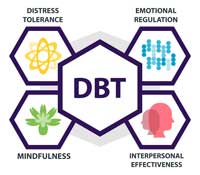
DBT teaches four core skill sets — Mindfulness, Distress Tolerance, Emotion Regulation, and Interpersonal Effectiveness — to help you navigate overwhelming emotions and build healthier relationships. Particularly effective for borderline personality disorder, self-harm, and suicidal ideation, and for managing the sustained emotional demands of military family life, the reintegration stress of post-deployment homecoming, and the relational consequences of deployment-related emotional numbing.
EMDR (Eye Movement Desensitization and Reprocessing) is among the most rigorously validated treatments for combat-related PTSD in the clinical literature, with robust evidence from veteran populations across every conflict since Vietnam. It involves recalling disturbing memories while focusing on bilateral stimulation, helping your brain reprocess traumatic memories and reduce their emotional intensity. For Iraq and Afghanistan veterans navigating senior military careers while carrying unprocessed operational trauma, EMDR often achieves results that years of general counseling have not.
Exposure and Response Prevention (ERP) Therapy
ERP is the gold-standard evidence-based treatment for OCD and related Anxiety Disorders. It involves gradually exposing you to feared thoughts or situations while helping you resist compulsive responses — breaking the OCD cycle and restoring your sense of control over your own mind.
Prolonged Exposure is one of the two most rigorously validated treatments for combat-related PTSD in the clinical literature, with extensive documentation of effectiveness in veteran populations. It involves gradually confronting feared memories and avoided situations in a safe therapeutic environment — processing the traumatic memory in detail to reduce its emotional power, and helping you regain control over what your nervous system treats as ongoing threat. For post-9/11 veterans carrying Iraq or Afghanistan-era trauma, PE has the strongest evidence base of any available treatment approach.
Other Therapy Techniques
Narrative Therapy: Encourages you to tell your story and reclaim ownership of your own experience — including the operational experiences that cannot be discussed outside a clinical setting; the experience of command decisions made under impossible conditions; and the specific complexity of being a high-performing professional whose career requires projecting strength while privately managing the weight of what service has cost.
Somatic Experiencing: Focuses on the body's physical response to trauma and works to release stored nervous system tension — particularly valuable for veterans whose operational trauma has settled into hypervigilance, chronic pain, sleep disruption, and the persistent physiological activation that combat experience can leave in the nervous system long after the deployments end.
Mindfulness and Relaxation Techniques: Present-moment anchoring grounded in Cumberland County's specific landscape — the Conodoguinet Creek winding across the valley floor; the walking trails along Yellow Breeches Creek; the view from South Mountain looking down the Cumberland Valley — as concrete, available anchors for a nervous system that has learned to treat peace as threat.
Psychoeducation: Understanding trauma and its effects in terms directly applicable to Cumberland County's military professional population — the neurological basis of combat hypervigilance; why moral injury presents differently from PTSD and requires different clinical approaches; how military family relocation stress accumulates across a career; and why the stoicism and self-reliance that make people effective in operational environments can actively prevent them from recognizing their own clinical needs.
Our Experienced Anxiety, Trauma, and PTSD Counselors
Our counselors are trained in Trauma-Informed Care and have extensive experience helping individuals heal from traumatic experiences — including the combat-related PTSD, moral injury, military family stress, and operational trauma carried by Cumberland County's large military community, and the anxiety, depression, and occupational trauma experienced by the county's civilian workforce, first responders, and families navigating a rapidly growing and historically complex region.
Choose Cumberland County's Anxiety, PTSD, and Trauma Experts
Certified Specialization in Combat Trauma, Moral Injury, and Military Family Stress: Advanced credentials in EMDR, Brainspotting, CBT, DBT, and Prolonged Exposure — all with specific clinical training for combat-related PTSD, military family dynamics, and the particular challenges of high-performing military professionals. General therapists with good credentials often lack this focus. ACRS clinicians have it.
Complete Confidentiality — No Military Career Visibility: What happens in your session is between you and your clinician. No chain-of-command visibility, no institutional reporting, no career consequences.
In Person (~40 Miles) or Telehealth: Lancaster is about 45 minutes from Carlisle. Or connect via secure video from quarters, from home, from wherever you are in the county.
No Waitlist, No Referral: A free 10-minute consultation, then we schedule. Available now.
Evening Hours Through Thursday: For working families, service members with demanding duty schedules, and anyone whose day doesn't end at 5 pm.
After World War I, the Army established one of the country's first formal psychiatric rehabilitation centers at Carlisle Barracks — because even then, the institution understood that combat trauma required specialized clinical attention. That recognition has not been consistently honored in the century since. The high-performing military professionals, spouses, families, and civilian workers of Cumberland County deserve clinical care that is as specialized, rigorous, and confidential as their service and sacrifice. ACRS provides it — 40 miles east, or through a secure connection from wherever you are.
Contact us for a free, confidential 10-minute consultation. We'll listen, answer your questions, and help you find the right path forward.
Cheryl has over 20 years of experience providing the highest-quality trauma and PTSD therapy to clients across Pennsylvania — including the high-performing military officers, veterans, spouses, and families of Cumberland County's garrison communities, whose specific clinical needs require exactly the specialized certification, discretion, and expertise that ACRS's certified traumatologists provide.
"The military community at Carlisle Barracks and NSA Mechanicsburg — and the Cumberland Valley families who have supported that community for generations — deserves trauma care that is as specialized, rigorous, and confidential as their service. ACRS is 40 miles east, or a secure connection from wherever you are. Call us."