Pike County's communities β from Milford's historic county seat to the Delaware River townships, from Hawley's lakeside neighborhoods to the deeply rural interior β deserve specialized trauma care delivered by Pennsylvania's most qualified traumatologists. With telehealth, that care comes directly to you, no matter how remote.
Pike County is Pennsylvania's most sparsely populated county in the northeastern corner of the state β a vast, forested landscape defined by the Delaware River on its eastern and southern borders, the Pocono plateau to the west, and the rolling woodlands and glacial lakes of the Upper Delaware region to the north. It is a county that the outside world mostly knows as a vacation destination β the Delaware Water Gap National Recreation Area draws millions of visitors each year β but the people who live here year-round inhabit a very different reality from the one visitors experience.
At Advanced Counseling and Research Services, our licensed trauma specialists bring evidence-based, certified trauma therapy directly to you through secure telehealth β so you can access the highest-quality care available in Pennsylvania without a long drive to Stroudsburg or Scranton, without crossing into New Jersey to find a provider, and without navigating a mental health system that has consistently underserved this region. From Milford to Matamoras, from Hawley to the most remote Delaware River township, we meet you where you are.
You don't have to leave Pike County to find a certified clinical trauma professional. Healing starts here.
Pennsylvania's Most Isolated County Carries Real, Unaddressed Trauma
Pike County's communities carry specific, layered burdens that general counseling approaches rarely recognize or reach. Our certified clinical trauma professionals are trained to work with exactly this kind of complex, place-shaped trauma:
Extreme geographic isolation and the total absence of specialized care: Pike County has no hospital, no psychiatric facility, and an acute shortage of any mental health providers β let alone certified clinical trauma professionals. Residents who need specialized care face drives of 45 minutes to an hour or more just to reach the nearest services in Monroe County or Wayne County, and often much longer for anything resembling certified trauma treatment. For residents of the county's more rural townships β Dingman, Lehman, Blooming Grove, or the communities along the upper Delaware β the isolation is near-total. Telehealth does not merely improve access in Pike County. For many residents, it is the only realistic path to specialized care.
The resort and second-home economy's toll on year-round residents: Pike County's economy is built around serving the vacation and second-home market β the Delaware Water Gap visitors, the lake house owners, the weekend tourists from New York and New Jersey. Year-round residents work in service industries that are highly seasonal, low-wage, and economically precarious. The contrast between the county as visitors experience it and the county as its permanent residents live in it is sharp and constant β a source of chronic stress and quiet resentment that compounds other forms of trauma.
The opioid and fentanyl crisis: Pike County has been among Pennsylvania's hardest-hit rural counties in the opioid epidemic, with per-capita overdose death rates that have ranked among the highest in the state. The convergence of geographic isolation, economic precarity, social disconnection, and near-total absence of treatment resources creates exactly the conditions in which addiction takes hold and recovery fails. Every family touched by overdose carries unresolved grief and trauma that will not heal without specialized help.
Veteran and first responder trauma: Pike County has a significant veteran population, and its emergency services are staffed almost entirely by volunteer departments stretched thin across the county's 547 square miles. First responders in Pike County often know the people they are responding to β sometimes intimately β and operate with minimal backup and without the support systems available to urban departments. The cumulative psychological toll is severe and rarely addressed. Specialized PTSD care for veterans and first responders is essentially unavailable locally without telehealth.
Domestic violence in total isolation: Geographic isolation makes Pike County one of Pennsylvania's most dangerous environments for domestic violence survivors. The combination of rural roads, limited transportation, no public transit, and small communities where keeping secrets is the norm creates profound barriers to seeking help. For many survivors, telehealth is the only way to access trauma-informed care without their abuser β or their neighbors β knowing they have reached out for help.
Long-haul pandemic trauma and COVID-19 grief: Pike County's combination of high second-home density, limited healthcare infrastructure, and economically vulnerable year-round population made it particularly susceptible to COVID-19's impact. The grief, loss, and ongoing anxiety generated by the pandemic β layered on top of preexisting community stressors β have been inadequately addressed, as they have across all of northeastern Pennsylvania's most underserved communities.
ACRS's certified clinical trauma professionals are trained specifically to work with complex, layered trauma β not just acute single-event PTSD. We meet you where you are.
Why Pike County Residents Choose ACRS
Personalized, Trauma-Informed Care β Delivered to Your Home
We work collaboratively with you to develop a Trauma-Informed Care Plan that addresses your specific needs and goals.
Specialized, compassionate PTSD care for Pike County veterans and active military families. You served β you deserve care that understands what you've been through.
First Responders
Pike County's volunteer firefighters, EMS crews, and state police troopers cover 547 square miles of forested, rural terrain β often responding alone, often to people they know, and always with minimal backup. Our trauma specialists understand the unique cumulative stress of first responder work in one of Pennsylvania's most isolated counties and provide confidential, effective telehealth care on your schedule, from your home.
Survivors of Domestic Violence
Individuals With Substance Use Disorders
Why Telehealth Works β Especially in Pike County
Pike County makes the case for telehealth more powerfully than almost any other county in Pennsylvania. It has no hospital. It has no inpatient psychiatric facility. The number of mental health providers per capita β let alone certified clinical trauma professionals β is among the lowest in the state. For residents of Milford, Dingmans Ferry, Hawley, Matamoras, and the county's scattered rural communities, the nearest specialized trauma therapist is likely an hour's drive away under the best conditions, and significantly more for those in the county's interior or northern townships.
Telehealth removes those barriers completely. With today's secure video technology, your session with an ACRS certified traumatologist is every bit as effective and connected as being in the same room. You see your therapist's face. They see yours. The therapeutic relationship is real β and so are the results.
Here's why Pike County clients tell us they value telehealth:
No long drive on Route 6, Route 739, or Route 209 before or after a difficult session β roads that are often dangerous in winter conditions.
Sessions fit around your work and family schedule β including evenings through Thursday.
You're in your own home β your own comfortable, private space.
In a small, tight-knit community, telehealth provides a level of privacy that in-person appointments in Pike County simply cannot offer.
You have access to Pennsylvania's best trauma specialists β certified clinical trauma professionals, not general therapists with long waitlists.
It works. Evidence-based telehealth therapy delivers outcomes comparable to in-person care for trauma, anxiety, and PTSD.
You must be physically located in Pennsylvania during your telehealth session. If you would prefer to visit us in person, our Lancaster office is approximately 115β130 miles from Milford via Interstate 84 and the Northeast Extension of the Pennsylvania Turnpike.
ACRS Treatment Modalities for Anxiety, Trauma, and PTSD
Brainspotting operates on the principle that where you look affects how you feel. A therapist helps you identify "brainspots" β eye positions linked to stored emotional experiences or trauma in the brain. By maintaining focus on the brainspot while fostering mindfulness and connection, the brain processes and releases unresolved emotions at a profound neurobiological level.
Brainspotting is effective for PTSD, Anxiety, Depression, chronic pain, and performance issues β and is particularly well-suited to the complex, layered trauma carried by Pike County communities shaped by displacement from New York City, economic precarity, racial inequity, and the deep isolation of rural life far from adequate care.
CBT is a short-term, goal-oriented psychotherapy that helps you identify and challenge unhelpful thought patterns and develop healthier coping mechanisms. It is highly effective for Anxiety, Depression, and PTSD β and its structured, practical approach resonates well with clients who value concrete progress and measurable results.
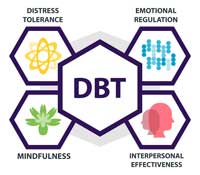
DBT teaches four core skill sets β Mindfulness, Distress Tolerance, Emotion Regulation, and Interpersonal Effectiveness β to help you navigate overwhelming emotions and build healthier relationships. Especially effective for borderline personality disorder, self-harm, and suicidal ideation.
EMDR (Eye Movement Desensitization and Reprocessing) is a gold-standard treatment for trauma and PTSD. It involves recalling disturbing memories while focusing on bilateral stimulation, helping your brain reprocess traumatic memories and reduce their emotional intensity. Effective for PTSD, Anxiety, Phobias, and other trauma-related conditions.
Exposure and Response Prevention (ERP) Therapy
ERP is the gold-standard, evidence-based treatment for OCD and related Anxiety Disorders. It involves gradually exposing you to feared thoughts or situations while helping you resist compulsive responses β breaking the OCD cycle and restoring your sense of control.
PE is a type of CBT used to treat PTSD and Anxiety disorders. It involves gradually confronting feared memories and avoided situations in a safe environment. Through repeated exposure, the anxiety associated with trauma triggers diminishes over time β helping you reclaim your life.
Other Therapy Techniques
Narrative Therapy: Encourages you to tell your story, helping you understand and reclaim your own experiences β including the stories of migration, displacement, and reinvention that define so many Pike County families, and that have rarely been heard by a clinician truly equipped to hold them.
Somatic Experiencing: Focuses on your body's physical response to trauma and works to release stored tension β particularly valuable for clients whose chronic stress or long-held trauma manifests as persistent physical symptoms.
Mindfulness and Relaxation Techniques: Meditation and deep breathing to help manage trauma-related stress and Anxiety β practices that can be particularly grounding for those living in the natural environment of the Delaware River region and Pocono highlands.
Psychoeducation: Understanding trauma and its effects β including the specific patterns common in displaced communities, economically marginalized populations, and individuals shaped by profound geographic isolation β to help you make sense of your own experiences.
Our Experienced Anxiety, Trauma, and PTSD Counselors
Our counselors are trained in Trauma-Informed Care and have extensive experience helping individuals heal from traumatic experiences β including the complex, layered trauma carried by Pike County residents navigating displacement, economic precarity, and the profound isolation of Pennsylvania's most rural northeastern county.
Choose Pike County's Anxiety, PTSD, and Trauma Experts
Specialized Expertise: Certified Traumatologists β not general counselors with long waitlists. We treat trauma, PTSD, and anxiety as our primary focus, with advanced training and credentials to match.
No Commute Required: Secure telehealth brings Pennsylvania's best trauma specialists directly to your home in Milford, Dingmans Ferry, Hawley, Matamoras, Lords Valley, Shohola, or anywhere in Pike County β no matter how remote your address.
Personalized Approach: We recognize that trauma in Pike County takes many forms β shaped by displacement from New York City, the isolation of rural life, the opioid crisis, and the experience of living in a county that the mental health system has largely left behind. Your care plan reflects your unique experience.
Taking the first step toward healing takes real courage β especially in a community where help has always been hard to find and the expectation has been to manage on your own, far from the resources other Pennsylvanians take for granted. You deserve specialized care, and you deserve it without leaving home to find it.
Contact us today to set up a free, confidential 10-minute consultation. We'll listen, answer your questions, and help you find the right path forward.
Cheryl has over 20 years of experience providing the highest-quality trauma and PTSD therapy to clients across Pennsylvania β including those in the most isolated communities, where the absence of adequate care has compounded the trauma itself and where people have waited far too long to be truly seen and heard.
"Pike County is one of Pennsylvania's most beautiful and most underserved places. The people who live there year-round β many of them families who came seeking a better life and found themselves truly on their own β deserve the same quality of trauma care as anyone else in this state. Telehealth makes that possible."